The Hunger That Follows
On intention, fiber, and what thirty years of eating in other people’s kitchens taught me about my own.

I was twenty-four years old, studying French in Bern, and I had just made a complete mess of dinner.
My closest friend there was the daughter of the Indian ambassador to Switzerland, and she had taken me to eat. I don’t remember the name of the restaurant. I remember everything else. The food arrived and she picked it up with her hands, moving through the meal with a naturalness I watched with genuine fascination. I attempted the same. I was not graceful. There was sauce. My arms got involved.
Afterward, walking back through the city, she said something I have never stopped thinking about. She told me she never felt full when she ate with forks and knives. That the utensils put a distance between her and the food that her body couldn’t close. She didn’t feel finished. She felt interrupted.
I had never heard anyone say that before. And I knew, the moment she said it, that something similar was true for me, though I didn’t yet have the language for what it was.
She wasn’t talking about hunger. She was talking about recognition. The body knowing it had been fed.
In the years after Bern I ate in a great many restaurants. Michelin-starred kitchens in France. Small tavernas in Greece. Noodle houses in Asia where the broth had been going since before I was born. And in almost every case, even the extraordinary ones, I noticed something about what happened two hours later.
I was hungry again. Not always, and not the same kind of hunger. But there was a particular restlessness that followed restaurant meals that I did not feel after cooking at home. I kept noticing it and not knowing what to call it.
What I have come to understand is that most professional kitchens are not organized around your true satiety, satiation at a cellular level. They are organized around your return. That is the business model. The food is built to be delicious, and it is, and the oils are chosen for cost and sometimes flavor and shelf life and the grains are processed for consistency and the fiber, the thing that actually closes the loop between eating and feeling fed, gets refined out somewhere along the way. Not from malice. From the logic of running a business.
Earlier this year I spent an afternoon on the phone trying to get a gastroenterology appointment in Los Angeles. I called twenty offices. The earliest anyone could see me was six months out. My father was doing the same thing from North Carolina at the same time. His wait was twelve months. We compared notes that evening, the two of us sitting with this information: that gut problems have become so common, so widespread, that the specialists who treat them can’t keep up.
What I have a theory about is the cause. The food supply has been quietly corrupted over the same generation that gut disease has risen: herbicides, pesticides, fungicides, GMO crops, plastics leaching into everything we eat and drink, chronic stress metabolizing through the gut wall, and now GLP-1 medications being handed out at scale to suppress the very appetite signals that should be telling us something about what we are eating. Protein is trending as the answer. But protein was never the question.
I don’t say this to alarm anyone. I say it because I watched the same pattern play out inside my own family, up close, over decades. My mother’s relationship with food was the central struggle of her life, one she fought without rest. She did not survive it. She died at fifty-nine with severe obesity on her death certificate. My daughter Penelope came close to the same place. Food addiction and obesity severe enough that it nearly killed her too.
What I know from watching that, and from thirty-five years of working at the intersection of food, psychology, somatics, and health, is that the body keeps a very honest account. It records everything. And what it needs, more than almost anything else we have stopped giving it, is to be trusted. To be given the foods it was built to recognize, the ones it knows how to use.
Our grandmothers cooked with it instinctively. Legumes. Whole grains. Bitter greens. Fermented things. Not because they understood the microbiome. Because they understood what left people feeling well.
The variety of fiber in these foods slows digestion in a way that tells the body the meal is complete. Without it, the body keeps signaling hunger even after a full plate, not because it wants more food but because it hasn’t received what it was built to process. A kind of cellular starvation, the body asking for nutrients it never received. This is not a metaphor. It is the mechanism behind much of what we are seeing right now in clinics and waiting rooms across the country.
When I cook at home, the health of the people at my table is what drives every decision, as does the flavor and the texture. The oil I choose, the grain I use, whether there are bitter greens alongside the protein. That intention is not separate from the flavor. It is what produces the flavor, because food grown and prepared with care tastes different from food engineered to hijack your gut and your tastebuds and keep you hungry for something your body can never quite find.
At a restaurant the driving logic is different, and the food and the hunger that follows both reflect it. This is not a criticism. It is just a fact I have made peace with by eating something real before I go out, and occasionally after I come home.
In the early 2000s I was in Washington with my sister and niece when I ordered a cauliflower steak for the first time. One of the early farm-to-table restaurants, the kind that had started taking vegetables seriously as a main event rather than a concession. What arrived was the whole cauliflower, roasted until the outside was deeply brown and the inside had gone tender, sweet, creamy, and dense. Unapologetically large. Thick as a proper cut of meat. Nothing apologizing for what it was.
I ate it and felt finished. Not stuffed. Finished. The particular completeness of a meal that has given the body something it recognizes. My sister and niece felt it too. We sat there for a moment without saying anything.
I went home and learned to make it. Then I learned to make it twenty-nine other ways. Then spent years teaching it to anyone who would listen, watching the same thing happen each time: someone who thought eating well meant eating less discovers that a vegetable given the whole center of the plate is not a compromise. For many people it becomes the bridge, the meal that shows them a different kind of eating is not only possible but more satisfying than anything they were doing before.
The body always knew what it needed. We just stopped trusting it.
Whole Roasted Cauliflower with Chermoula
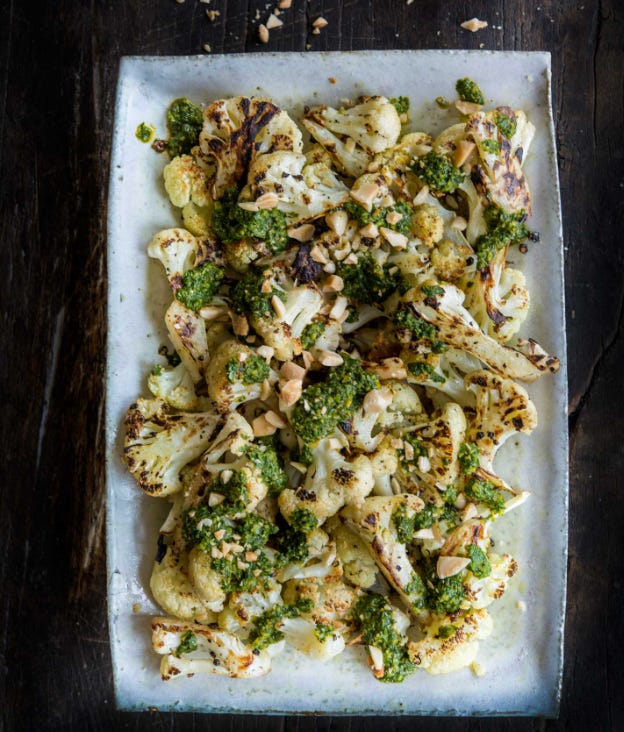
When you roast it whole, the outside chars and concentrates while the inside steams itself into something tender and almost sweet. It takes patience and almost no technique. The chermoula underneath is bright and acidic and cuts through the richness in a way that makes the whole thing feel like a complete thought. Bring it to the table whole and let people pull it apart themselves.
A whole head of cauliflower carries roughly ten grams of fiber along with sulforaphane, choline, and a range of B vitamins. Roasting concentrates the glucosinolates that support liver detoxification. The olive oil carries the fat-soluble compounds across the gut lining. This is not diet food. It is one of the most nutritionally complete vegetables available, and this recipe treats it accordingly.
Serves 2 to 4
FOR THE CAULIFLOWER
1 whole head cauliflower, leaves trimmed, stem left intact
4 tablespoons good olive oil
1 teaspoon flaky salt
1 teaspoon cumin
Half teaspoon smoked paprika
Half teaspoon turmeric
Black pepper
FOR THE CHERMOULA
Large bunch of fresh cilantro, roughly chopped
Large bunch of fresh flat-leaf parsley, roughly chopped
3 garlic cloves
1 teaspoon cumin
1 teaspoon smoked paprika
Half teaspoon coriander
Pinch of cayenne
Juice of 1 lemon
5 tablespoons good olive oil
Unrefined salt to taste
TO SERVE
Labneh or thick yogurt (or coconut yogurt)
Toasted almonds or pine nuts
Lemon wedges
Extra fresh herbs
METHOD
Heat the oven to 400 degrees Fahrenheit, 200 Celsius. Make the chermoula first so the flavors have time to come together. Blend or pound the cilantro, parsley, garlic, spices, lemon juice, and olive oil into a rough bright green paste. Taste it. Adjust salt and lemon. Set aside.
Bring a large pot of salted water to a boil. Lower the cauliflower in carefully and simmer for eight minutes. This par-cooks the dense core so everything roasts through evenly. Drain and pat dry.
Mix the olive oil with the cumin, paprika, turmeric, salt, and pepper. Rub it all over the cauliflower, getting into every crevice. Place it upright on a baking tray.
Roast for 45 to 55 minutes until the outside is deeply golden and a knife slides into the center without resistance. The outer florets should have dark edges. That is the point.
Spread the labneh across a large plate or board. Set the whole cauliflower on top. Spoon the chermoula generously over and around it. Scatter the toasted nuts. Finish with lemon wedges and herbs.
Bring it to the table whole. There is something about eating from a shared whole vegetable that changes the meal. You will notice it.
On the tahini version
Roast the cauliflower the same way and serve it with tahini sauce instead: three tablespoons tahini, juice of one lemon, one small garlic clove grated, a pinch of salt, enough cold water to make it pourable. It is a different dish and equally good. Both have been made in my kitchen more times than I can count.
Helene Leeds
Helene Leeds is a culinary medicine practitioner and MasterChef Season 3 finalist who has spent thirty-five years at the intersection of food, somatics, metabolism, and psychology. Trained in the culinary traditions of France, Germany, Greece, Switzerland, and Asia, she writes about what real cooking does to the body and the mind. She lives in Los Angeles and teaches and cooks every day.
If this found its way to you through a friend, you can subscribe here. Every issue: one essay, one recipe, one idea worth sitting with.