The Taste Reset
The Day Real Food Stopped Feeling Like Medicine

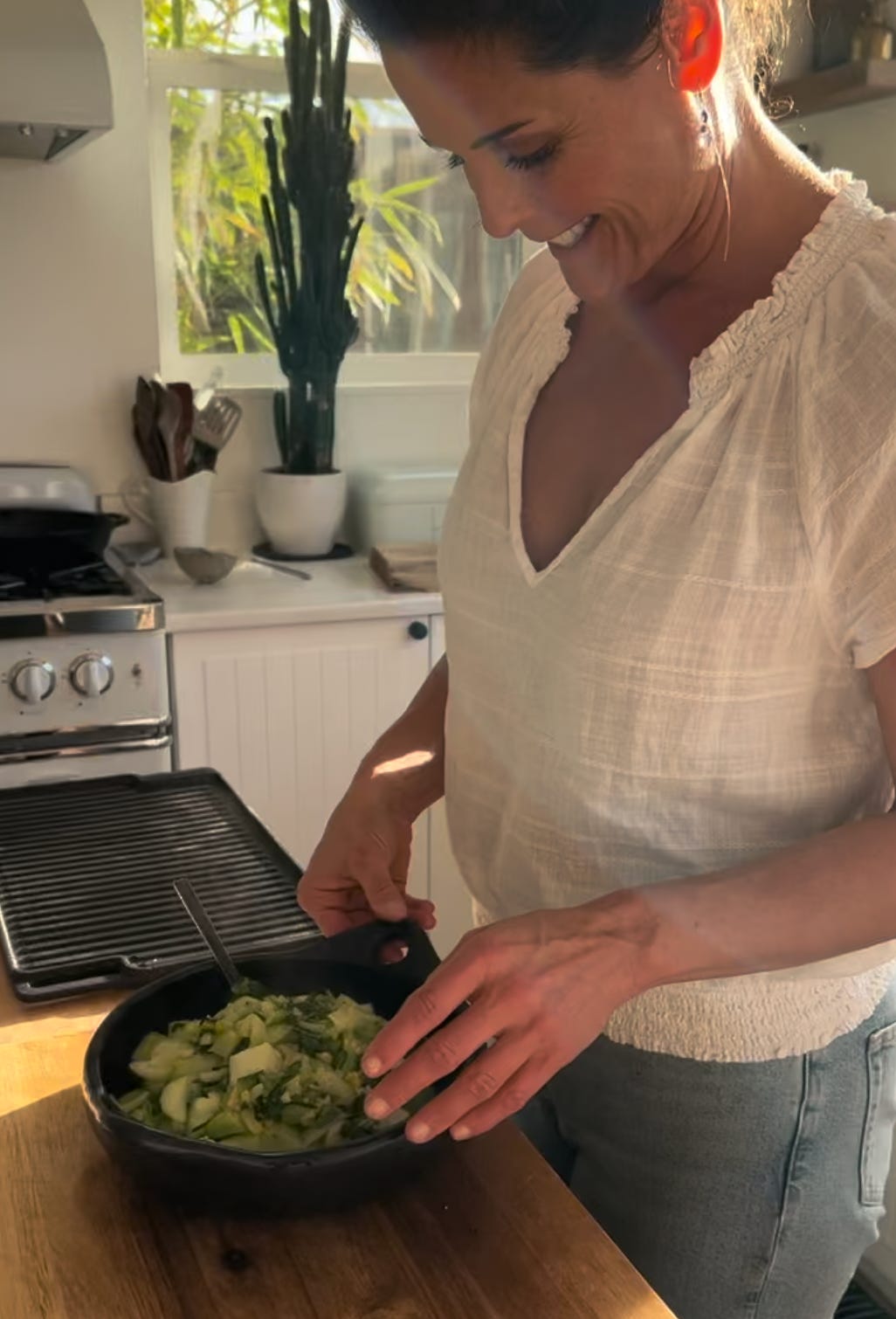
On what the body already knows, and the long education of learning to trust it.
The doctors at Lenox Hill were not pleased.
I could tell by the silence that fell over the examination room when they looked at the imaging and found nothing there. The vocal nodes were gone. The surgery they had predicted, the procedure they had mapped out in careful clinical language, had nothing left to operate on.
They shrugged. It was not the shrug of relief.
I had not done what they asked. Instead of booking the operating room, I had spent three months working with Chinese herbs, following a protocol thousands of years old. I tried it on a whim, because there had to be a more viable solution than surgery and risking losing my voice forever.
My voice came back. The nodes, those small stubborn accumulations of misuse and strain, had dissolved.
I had been trained as a classical singer since I was four years old. I was eighteen when I lost my voice. It was the central channel of my life, the perfecting of vibration, sound, and breath, and then suddenly it wasn’t there. I wasn’t looking for an adventure in alternative medicine. I wanted the wholeness of being able to sing.
The body, I was learning, had a language of its own.
But I had been in examination rooms before that. The first time, I was seven.
Fairfax Hospital, Virginia. The memory is vivid. I remember sitting on the floor of an unusual examination room, because my white blood cells were unexplainably high, with x-rays of my own body covering all four walls, floor to ceiling. They had found a spot. They suspected leukemia. There would be a bone marrow biopsy to find out what was happening inside the bones of a child who had not yet finished learning to read.
I remember being curious but aware that my mother was frightened. I studied those x-rays with genuine interest while sitting next to her, wanting to assure her everything would be okay. Children’s cancer wards have a particular quality to them. How do you make sense of children getting sick? I was more worried about her than about myself.
It was not leukemia. It was osteomyelitis, a bone marrow infection that required a year of IV antibiotics to treat. A full year. I was seven. I was in and out of the hospital so many times I lost count. The catheter kept falling out of my arm when I used crutches, which I called crotches at the time, so they put me in a wheelchair in an era before ramps.
That year taught me something I have never forgotten: my health was my freedom. Nothing else was possible without it.
We treated it, and it worked, and in one version of that story we are simply grateful and move on but it left an unforgettable imprint of ne observing my friends coming into their bodies while I was seated in a wheelchair struggling to get from point a to point b. Ostricism and obesity followed, I was the only 3rd grader who weighed 100 lbs.
But I grew up in a house where food was never simply fuel.
My parents were divorced, and many things separated them. Food was not one of those things.
Both of them knew, in their different ways, that what you eat is not a neutral act. My mother was in Food Addicts Anonymous, also known as Overeaters Anonymous. She understood, through the hard specific knowledge of someone who has fought something, won and lost and fought again, that food could be harm as readily as it could be love, and that the line between them is sometimes blurred. Together, despite the divorce, despite everything, they had built a household where the table was the center of it all: the celebrations, the crises, the repairs.
Our lives revolved around food. We just didn’t always agree on what kind.
It was my mother who first showed me that food could be medicine in the literal sense. She had macular degeneration, fundus flavimaculatus, a condition affecting the texture of her macula. She was losing her sight. Then she changed what she ate, following a macrobiotic diet. Three months later, her vision was restored. Her doctors, like the doctors at Lenox Hill a decade later when my nodes dissolved, had very little to say about it.
There was a neighbor whose cancer reversed on that same diet. I watched that too, the way a child watches things she doesn’t yet have words for.
I was accumulating evidence without knowing what to do with it.
What I was learning was not that medicine was wrong. The body had a broader intelligence than medicine, at that time, was willing to credit. Yet all through Europe and Asia, thousands of years of practiced medicine had already validated it.
I spent the next three decades decoding what I had witnessed and bringing language and experience to it.
I trained in European culinary traditions, France, Germany, Greece, Switzerland, and in Asia as well, and what struck me, over and over, was how naturally those traditions held the relationship between food, healing, and the body. There were nourishing traditions with unbroken through-lines. Not problems or protocols. Just fact: that what you eat shapes your mind and body, that seasonal cooking is a form of metabolic intelligence. Bitter greens before a meal. Warm spices in winter. Fermented things alongside meals. These were not health trends. They were the accumulated knowledge of ten thousand years of humans paying attention to how food choices heal.
I became a culinary medicine practitioner. I began working at the intersection of food, metabolism, psychology, and the nervous system. I found the microbiome research that was finally giving rigorous language to things I had watched happen in actual bodies, my mother’s, my neighbor’s, eventually my own voice returning.
Along the way I also lived my own story with food and weight. My mother died at fifty-nine with severe obesity on her death certificate. My daughter Penelope was three hundred and twenty pounds at fifteen. I watched her lose a hundred and sixty of them. We worked with food, not against the body, and what shifted was deeper than weight. We came to understand that we could change the expression of genes we had been told were simply our inheritance.
And somewhere in all of that, something shifted for me too.
Real food stopped feeling like medicine. Not because it stopped working. It still astonishes me, how reliably it works. But I stopped approaching it as a corrective. Food became again what it was in the best moments of my childhood: the smell of something roasting, the pleasure of a meal that was whole and healing, that leaves you satiated at a cellular level.
The doctors at Lenox Hill shrugged when my nodes dissolved. I have thought about that shrug many times since. What it contained. What it could not accommodate, understand, or willingly accept with curiosity.
They were working inside a system that has very little room for the possibility that ancient wisdom bridges to modern life, that there are viable solutions to everyday problems in the wisdom of how and what we eat.
That is the question I keep returning to. (this doesnt make sense now - is there a question?)
Whether food is medicine, that one has been answered, in many bodies, including mine. Emphatically the answer is, yes. What I sit with is something harder: what would change if we stopped treating the body’s own intelligence as something to be corrected and started treating it as something to be nourished, integrated and digested.
There is no one size fits all. What I have is thirty-five years of watching what happens when you give the body something real, something it recognizes, made from your hands and your kitchen. And the pleasure of thinking out loud with people asking the same things.
That’s what this is. Come in.
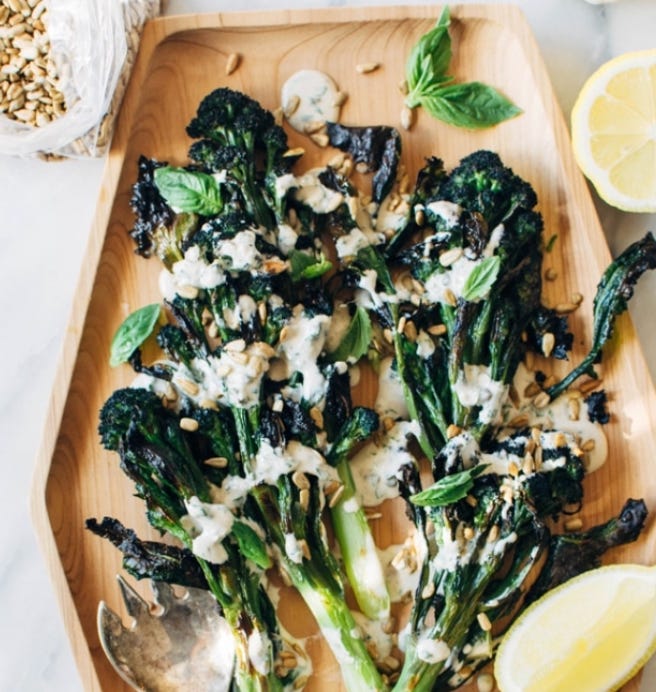
Charred Broccoli with Garlic Yogurt and Toasted Seeds
On paper this dish is almost nothing. In practice it is the kind of thing you make once and then find yourself thinking about. The broccoli needs real heat, not gentle roasting but genuine char, where the edges blacken and the stems concentrate into something almost sweet. The garlic yogurt underneath is cooling and lactic against the bitterness. The seeds give it enough crunch that the meal feels like a meal.
The bitter compounds in charred brassicas, sulforaphane and glucosinolates, are among the most studied metabolic signals in food. They prompt the liver to produce detoxifying enzymes and support microbial diversity in the gut. You don’t need to know that to understand what this dish does. You just need to eat it and pay attention to how you feel afterward.
Serves 2 to 4
FOR THE BROCCOLI
1 large head broccoli, about 600g, cut into florets, stems sliced into coins
3 tablespoons good olive oil
Flaky salt
Black pepper, generously applied
Pinch of dried chili flakes
FOR THE GARLIC YOGURT
200g full-fat plain yogurt, Greek or labneh both work
1 small garlic clove, grated to a paste with a pinch of salt
1 tablespoon lemon juice
Pinch of salt
FOR THE SEEDS
3 tablespoons mixed seeds, sunflower, pumpkin, sesame, or whatever you have
1 teaspoon olive oil
Pinch of cumin
Pinch of salt
TO FINISH
Good olive oil
Lemon zest
Small handful of fresh herbs, flat-leaf parsley, dill, or mint
METHOD
Heat your oven as high as it will go, 500 degrees Fahrenheit or 260 Celsius if you can get there. Line a large baking sheet with nothing. The broccoli should sit directly on the pan.
Toss the broccoli with olive oil, salt, pepper, and chili flakes. Spread it in a single layer with real space between the pieces. Crowding steams rather than chars. Roast for 18 to 22 minutes, turning once halfway through, until the edges are deeply browned and the stems are tender. Those dark edges are the whole point.
While the broccoli roasts, make the garlic yogurt. Combine yogurt, garlic paste, lemon juice, and salt. Taste it. It should be bright and slightly sharp. Let it sit at room temperature. Cold yogurt under hot vegetables is worth the extra few minutes.
Toast the seeds in a dry skillet over medium heat with the olive oil, cumin, and salt. Stir constantly. They will go from pale to fragrant to burnt faster than you expect. Three to four minutes, then off the heat.
Spread the garlic yogurt across the bottom of a wide plate or shallow bowl. Lay the hot charred broccoli over it. Scatter the toasted seeds. Drizzle with olive oil. Finish with lemon zest and fresh herbs.
Eat it while the broccoli is still hot and the yogurt is still cool. That contrast matters.
A note on the science
The full-fat yogurt earns its place. The fat carries fat-soluble compounds from the broccoli more efficiently and provides the short-chain fatty acids that feed the gut lining directly. The garlic is prebiotic. The seeds add fiber and zinc. Good cooking, followed honestly over centuries, tends to arrive at these things on its own.
Helene Leeds is a culinary medicine practitioner and MasterChef Season 3 finalist who has spent thirty-five years at the intersection of food, metabolism, and human psychology. Trained in the culinary traditions of France, Germany, Greece, Switzerland, and Asia, she writes about what real cooking does to the body and the mind. She lives in Los Angeles and cooks every day.